


.webp)


Amid the global digital transformation wave, optical fiber serves as the core carrier of information transmission, underpinning the normal operation of global communication networks including cross-border communications, data center interconnection, and 5G base station deployment. From submarine cables connecting continents to high-speed links within data centers and gigabit broadband access to homes, optical fiber has permeated every corner of the globe. Today, we bring you a comprehensive, practical guide to optical fiber fundamentals, breaking down its core principles, classifications, and key parameters, while integrating relevant products from Fibermart to bridge theory and real-world application. Whether you are an industry novice or a technology enthusiast, you will quickly grasp the essential takeaways.
Definition and Structure of Optical Fiber: Thinner Than a Human Hair, Yet Capable of Carrying Massive Data
Optical fiber, short for optical waveguide fiber, is a thin filamentous material made of quartz glass or special plastics, with a diameter of only about 0.1mm—thinner than a human hair. It features a unique structure that traps optical signals inside and transmits them efficiently along the axial direction. Its core structure consists of three layers, from the inside out: the core, cladding, and protective coating. These three components work in tandem to ensure stable optical signal transmission, which is the core advantage of optical fiber over traditional metal cables.
-
Core: The central transmission part of the optical fiber, typically 8–10μm in diameter for single-mode fiber and 50–62.5μm for multi-mode fiber. It is mainly made of high-purity quartz glass doped with specific elements to increase its refractive index, serving as the primary channel for optical signal transmission.
-
Cladding: Wraps around the core and has a slightly lower refractive index. This refractive index difference satisfies the condition for total internal reflection of light, trapping optical signals firmly within the core to prevent optical energy leakage, while also protecting the core from minor abrasions.
-
Protective Coating: The outermost layer made of plastic or rubber. Its main functions are to enhance the mechanical strength of the optical fiber, prevent breakage and wear, and provide moisture and corrosion resistance, adapting to various indoor and outdoor installation environments.
-
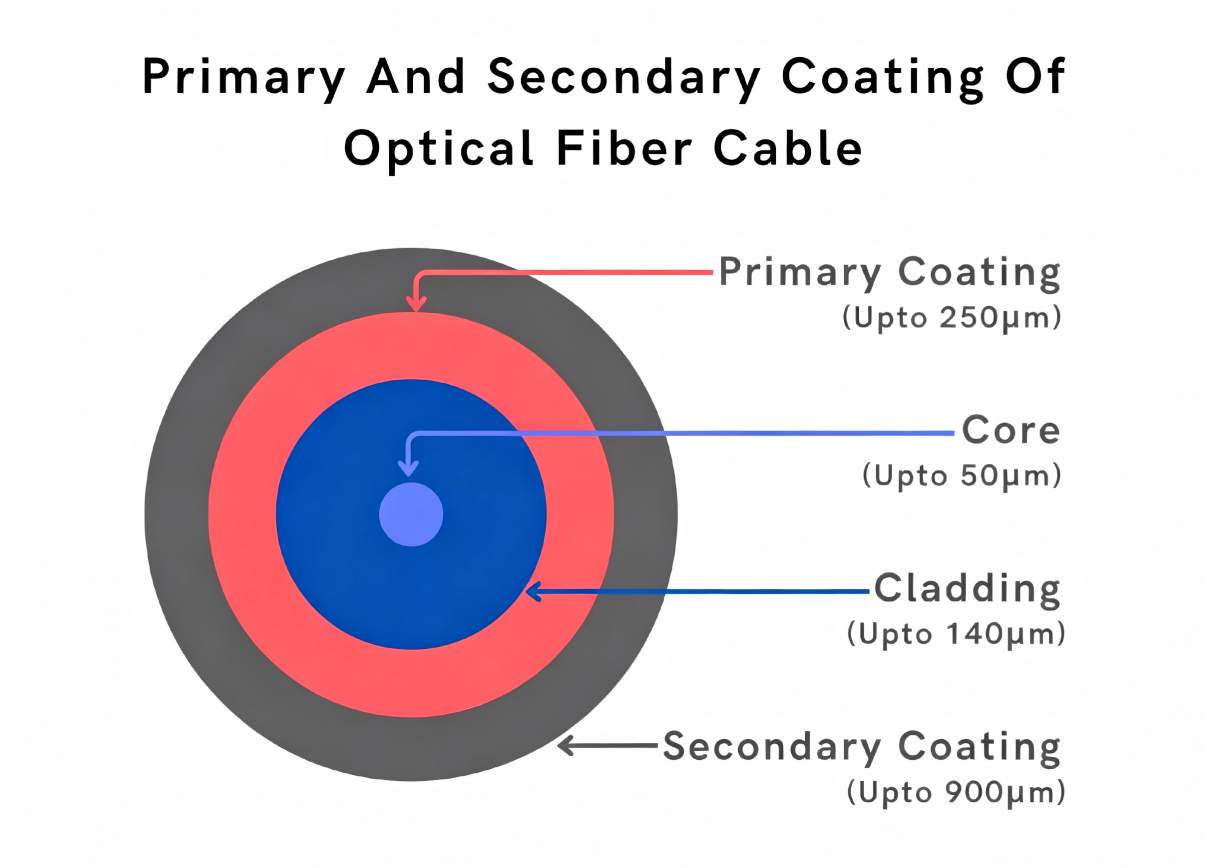
Bonus Insight: The core principle of optical fiber transmission is the "total internal reflection of light". When an optical signal enters the core at a specific angle, it undergoes total internal reflection at the interface between the core and cladding, bouncing back and forth continuously within the core to achieve long-distance, low-loss signal transmission. Even if the optical fiber is slightly bent, as long as the bending angle does not exceed the critical value, the optical signal can still be transmitted normally with minimal additional loss—this is the key reason optical fiber can adapt to complex cabling environments.
Classifications of Optical Fiber: Single-Mode vs. Multi-Mode for Diverse Global Applications
|
Comparison Dimension |
Single-Mode Fiber (SMF) |
Multi-Mode Fiber (MMF) |
|---|---|---|
|
Core Diameter |
Extremely thin, typically 9μm (industry standard), with a uniform cladding diameter of 125μm |
Relatively thick, common specifications are 50μm or 62.5μm, with the same 125μm cladding diameter |
|
Transmission Mode |
Transmits only one mode of optical signal |
Transmits multiple modes of optical signals simultaneously |
|
Key Advantages |
Extremely low loss, long transmission distance, extremely high bandwidth |
Low cost, high coupling efficiency with light sources |
|
Key Specifications |
Attenuation ≤0.36dB/km at 1310nm wavelength; ≤0.22dB/km at 1550nm wavelength, theoretical transmission distance of up to hundreds of kilometers |
Bandwidth typically ranges from tens to hundreds of MHz·km, transmission distance generally does not exceed 500 meters, used at 850nm or 1300nm wavelengths with relatively higher attenuation |
|
Global Application Scenarios |
International submarine cables, global 5G core network backhaul, large-scale data center interconnection (DCI), long-haul trunk transmission, etc. |
Intra-rack interconnection in data centers, enterprise campus local area networks, building structured cabling, Fiber to the Desk (FTTD), and other short-distance scenarios |
Key Technical Parameters of Optical Fiber: Indicators for Performance Evaluation
Whether selecting optical fiber products or assessing the transmission quality of global optical fiber networks, the following three key parameters are the core basis. Mastering these will allow you to quickly judge the suitability of optical fiber and avoid common pitfalls.
-
Attenuation: The degree of reduction in optical power during transmission through optical fiber due to material absorption, scattering, and other factors, measured in dB/km. Lower attenuation means longer transmission distance, making it the most critical performance indicator of optical fiber. The attenuation of mainstream global single-mode fiber at 1550nm wavelength can be as low as 0.20dB/km, which is the core advantage for long-distance communications.
-
Bandwidth: The amount of information that an optical fiber can transmit per unit time, measured in MHz·km (for multi-mode) or Hz (for single-mode). Wider bandwidth means higher transmission rates and support for more services (such as 4K/8K video, cloud computing, and big data transmission). The bandwidth of single-mode fiber is theoretically unlimited, limited in practice only by the performance of light sources and detectors, while the bandwidth of multi-mode fiber is relatively limited.
-
Numerical Aperture (NA): An indicator measuring the ability of an optical fiber to receive optical signals. A larger numerical aperture means a wider angular range for receiving optical signals, higher coupling efficiency with light sources, and easier installation and debugging. The numerical aperture of single-mode fiber is typically around 0.12, and that of multi-mode fiber is around 0.20, adapting to different types of light sources.

Global Applications of Optical Fiber: Penetrating Every Digital Sector
With the acceleration of global digital transformation, the application scenarios of optical fiber have expanded from traditional communications to industry, healthcare, aerospace, and many other fields, becoming the "nerve center" of the global digital economy. Below are the four most mainstream application scenarios worldwide, providing an intuitive understanding of the importance of optical fiber:
-
Global Backbone Communication Networks: As the core carrier for cross-border and intercontinental communications, submarine optical cables and terrestrial backbone optical cables form the "aorta" of global communications, supporting the stable transmission of international calls, internet data, financial transactions, and other cross-regional services, and serving as the foundation for global interconnection.
-
Data Center Interconnection (DCI): High-speed connections between large global data centers rely on single-mode fiber and high-rate optical modules to achieve rapid data synchronization and resource pooling, supporting the large-scale development of cloud computing, big data, and artificial intelligence.
-
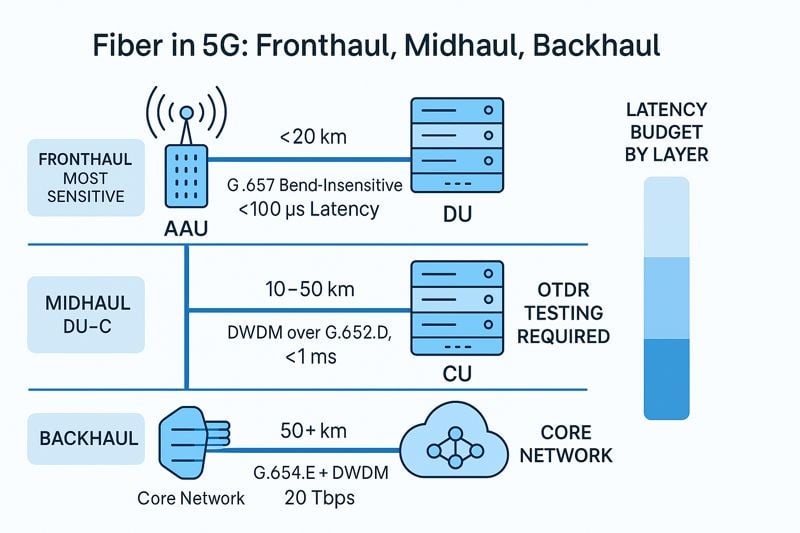
5G Mobile Communication Networks: Both the fronthaul (AAU to DU) and backhaul (DU to core network) of 5G base stations depend on optical fiber for high-speed signal transmission. Single-mode fiber, in particular, meets the low latency, high bandwidth, and massive connectivity requirements of 5G, driving the global rollout of 5G networks.
-
Civil and Industrial Applications: In scenarios such as Gigabit Fiber to the Home (FTTH), enterprise campus cabling, medical imaging transmission, and aerospace communications, optical fiber improves service quality and transmission efficiency with its advantages of low loss and anti-interference, becoming an important support for digital life and industrial upgrading.
Relevant Products from Fibermart: Tailored for Global Optical Fiber Application Needs
To address diverse optical fiber application scenarios worldwide, Fibermart offers a comprehensive range of optical fiber-related products, including core passive components such as optical fiber patch cords and adapters. With complete specifications, rich models, and stable performance, our products are universally compatible with all single-mode and multi-mode fiber applications, and are widely used in global data centers, telecommunications operators, and enterprise campuses. Below is a detailed introduction to specific models to help global users make precise selections.
Optical Fiber Patch Cords: Core Connection Components for Optical Fiber Links
Fibermart's optical fiber patch cords are available in full single-mode and multi-mode series, precisely matching the application requirements of different optical fibers outlined in the table above. Interfaces cover all global mainstream specifications including SC, LC, FC, and ST. Our core recommended models and details are as follows:
● Core single-mode model SM-LC-SC-SX-FM: Compatible with 9/125μm single-mode fiber, featuring an LC-SC dual-interface design and 2-meter length. It has an insertion loss ≤0.2dB, return loss ≥45dB, and an operating temperature range of -40°C to 85°C. Ideal for medium and short-distance scenarios such as global 5G core network backhaul and data center interconnection, balancing stability and practicality.
● Multi-mode flagship model OM2-SC-SC-DX-FM: Compatible with 50/125μm and 62.5/125μm multi-mode fiber, with easy-to-plug SC-SC interfaces and 1-meter length. Compliant with OM2/OM3 multi-mode fiber standards, it offers sufficient bandwidth and is suitable for short-distance, high-frequency connection scenarios such as enterprise campus local area networks and building structured cabling.
● 10G multi-mode model OM3-LC-LC-DX-FM: Compatible with OM3 50/125μm multi-mode fiber, with compact LC interfaces for high-density cabling. Meets the high-speed intra-rack interconnection requirements of data centers.
All patch cords use high-purity quartz cores with wear-resistant and moisture-proof outer protection, comply with global universal communication standards, and are compatible with all major optical equipment worldwide.
Optical Fiber Adapters: Precision Transition Components for Reliable Optical Fiber Connections
As key transition devices in optical fiber links, Fibermart offers a variety of precisely matched adapters covering all global mainstream interface transition needs. Our core models include:
● Single-mode transition model AD-SC-LC-M-SX-FM: Supports bidirectional transition between SC and LC interfaces, compatible with 9/125μm single-mode fiber. It uses a precision ceramic ferrule, with insertion loss ≤0.15dB and return loss ≥45dB. Ideal for scenarios requiring high stability such as 5G base stations and long-haul trunk transmission.
● Multi-mode transition model AD-LC-LC-OM3-SX-PF-FM: Features an LC-LC dual-interface design, compatible with 50/125μm and 62.5/125μm multi-mode fiber. It offers smooth plugging and unplugging and excellent sealing, suitable for short-distance transition scenarios in data centers and enterprise equipment rooms.
● Universal transition model AD-FC-SC-SPM-SM-SXC-FM: Supports transition between FC and SC interfaces, dedicated for single-mode fiber. It has strong fastening performance and excellent anti-interference, suitable for outdoor communication equipment and optical distribution frames.
All adapters feature anti-oxidation housings with superior protection performance, comply with global universal standards, and are perfectly compatible with the full range of Fibermart optical fiber patch cords, providing reliable support for the construction of global optical fiber links.

Conclusion: Optical Fiber is the Core Cornerstone of Global Digitalization
This concludes our comprehensive guide to optical fiber fundamentals, covering structure, classification, key parameters, global application scenarios, and compatible products from Fibermart. We hope you now have a thorough understanding of optical fiber. The advent of optical fiber has completely broken the distance and bandwidth limitations of traditional communications, propelling the world into the era of high-speed interconnected digitalization. Whether building global communication networks, upgrading enterprise digitalization, or popularizing home broadband, optical fiber plays an indispensable role.
We will share more practical knowledge in the future, including optical fiber installation techniques, troubleshooting, and technological iterations. Follow us to unlock more useful optical fiber insights and learn about additional Fibermart products tailored for global scenarios, helping you achieve more efficient and stable optical fiber applications.

Frequently Asked Questions (FAQs)
What are the core and cladding dimensions for single-mode and multi-mode fiber?
The cladding diameter is uniformly 125μm for both; the single-mode core is approximately 9μm, and the multi-mode core is 50μm or 62.5μm.
Can single-mode and multi-mode fiber be mixed? Why?
Mixing is not recommended. Their different core diameters and transmission modes will cause excessive signal loss and unstable transmission.
What are the main sources of optical fiber attenuation?
The main sources are material absorption (e.g., hydroxyl ions, impurities), optical scattering, and additional loss from fiber bending exceeding the critical angle.
What is the core difference between 1310nm and 1550nm wavelengths for single-mode fiber?
1550nm has lower attenuation (≤0.22dB/km) and is suitable for long-distance transmission, while 1310nm is more cost-effective for medium and short-distance applications.
What advantages does a larger optical fiber Numerical Aperture (NA) offer for B-side cabling?
It improves optical signal coupling efficiency, reduces the difficulty of interface alignment during cabling, and simplifies installation and debugging.
What are the core differences between single-mode and multi-mode fiber?
Different core diameters (single-mode ~9μm, multi-mode 50/62.5μm); single-mode fiber has longer transmission distance and larger bandwidth for long-distance scenarios, while multi-mode fiber is lower cost and has higher coupling efficiency for short-distance scenarios.
What are the core advantages of optical fiber over traditional metal cables?
Low loss, long transmission distance, large bandwidth, and immunity to electromagnetic interference, making it suitable for long-distance and high-frequency transmission needs in B-side applications.





No comments have been posted yet.